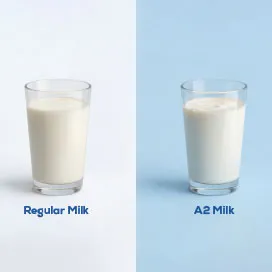
A2 Milk vs Regular Milk. Which Is Better for Your Child’s Digestion & Health?
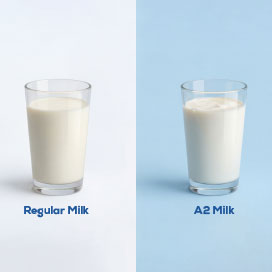
A2 Milk vs Regular Milk. Which Is Better for Your Child’s Digestion & Health?
1. A2 Milk vs Regular Milk. Which Is Better for Your Child’s Digestion & Health? ______________________________________________________________________________________________________________ For urban Indian parents today, raising a healthy child often feels like a careful balancing act between tradition and information. We still believe in time-tested habits like early bedtimes, home-cooked meals, and that daily glass of milk, but we are also far more aware than previous generations. Labels are read. Sources are questioned. And what once felt simple now invites deeper thought. Milk, especially, has quietly become a topic of debate. Once considered a universal good, it is now discussed in terms of digestion, protein types, sourcing, and even animal welfare. And this has led many parents to ask a very specific, very modern question: A2 milk or regular milk, what is actually better for a child’s health? This question isn’t rooted in fear or food fads. It comes from care. From noticing that some children complain of stomach discomfort, irregular digestion, or unease after drinking milk. From wanting to do better when it comes to everyday nutrition. Milk and Childhood: Why It Still Matters Despite evolving food habits, milk continues to play an important role in the growth of children. It is one of the most accessible sources of high-quality protein, calcium, phosphorus, and essential vitamins that support bone development, muscle growth, and neurological function. In Indian households, cow milk for kids has long been woven into daily routines, mixed with cereals, turned into curd, added to existing food dishes, or simply served warm before bedtime. For many children, milk is not just nutrition, it tastes like love and comfort. This makes milk for a child’s nutrition deeply significant. When a food is consumed daily, even small differences in how the body responds to it can compound over time. Which brings us to the core of the discussion.
Understanding Beta-casein: A1 and A2 Explained Simply To truly understand the A2 milk vs regular milk conversation, we need to look at milk protein. One of the key proteins in cow’s milk is beta-casein. There are two primary variants of this protein, A1 and A2. When people look up beta-casein A1 and A2, they are often surprised to learn that this difference is genetic, not industrial. Indigenous Indian cow breeds naturally produce milk containing only A2 beta-casein. Many high-yield crossbred or foreign breeds, however, produce milk containing A1 beta-casein or a mix of both. This distinction has nothing to do with fortification or processing. It is simply about the kind of cow the milk comes from. Why Digestion Changes the Conversation Children’s digestive systems are still developing, which makes milk digestion in children more sensitive than in adults. While both A1 and A2 milk provide similar nutrients on paper, they behave differently during digestion. Some studies suggest that when A1 beta-casein is digested, it can release a peptide known as BCM-7. In certain individuals, especially children, this peptide may be associated with digestive discomfort such as bloating, gas, constipation, or general unease. A2 milk, by contrast, does not release BCM-7 in the same way. This is why many parents researching A1 and A2 milk digestion have found evidence that A2 milk feels gentler on a child’s stomach. It is important to clarify that this is not about lactose intolerance. Lactose is a sugar; beta-casein is a protein. A child may digest lactose well and still respond differently to A1 protein.
Is There a Difference Between A1 and A2 Milk for Children? This is one of the most frequently asked questions among urban parents. Is there a difference between A1 and A2 milk for children? The honest answer is that it depends on the child. Some children show no noticeable difference at all. Others, particularly those who experience recurring digestive discomfort, irregular bowel movements, or fussiness after milk consumption, may respond better to A2 milk. What makes this distinction important is frequency. Milk is not an occasional food, it is often consumed daily. Over time, even mild digestive stress can influence appetite, mood, and overall comfort. Nutritional Comparison: Looking Beyond the Label When parents explore the A2 milk and regular milk nutritional difference, the nutrition labels can appear nearly identical. Both contain similar levels of calcium, protein, fats, and essential vitamins. The real difference lies not in nutritional quantity, but in how easily those nutrients are absorbed and tolerated. Nutrition is not just about what enters the body, it is about what the body can comfortably use. This perspective is especially important when evaluating milk for children nutrition, where digestion and absorption play as big a role as nutrient density. Purity, Antibiotics, and Why Sourcing Matters Protein type is only one piece of the puzzle. For many urban families, concerns around adulteration, antibiotic residues, and excessive processing have become just as important. Milk that supports the growth of children should be clean, traceable, and responsibly produced. Antibiotic overuse in dairy farming can lead to residues in milk and contribute to broader health concerns. This is why antibiotic-free practices matter, not just ethically, but nutritionally. Farm-to-home brands like OvinO focus on milk that is unadulterated, minimally handled, and sourced from healthy cows. When milk travels shorter distances and undergoes fewer interventions, it retains its natural nutrients and strength.
Making a Thoughtful Choice Without Pressure Choosing between A2 milk and regular milk does not require dramatic lifestyle changes. It requires observation. Parents can pay attention to how their child feels, digests, and behaves after consuming milk. If digestion is smooth and the child is comfortable, that itself is valuable information. If issues persist, exploring alternatives like A2 milk may be worth considering. The Verdict Milk has always symbolised care and warmth in Indian homes. What has changed is not the habit, but the awareness behind it. Understanding milk digestion in children, protein differences, and sourcing allows parents to make better, more informed decisions. Sometimes, better health does not come from adding more supplements or switching routines overnight. Sometimes, it begins with choosing milk that is simpler, gentler, and aligned to digestion. The easiest way to answer the ‘A2 Milk vs Regular Milk’ debate is by noticing how your child feels after finishing their glass.
Related Posts
Fresh reads to brighten your day